Facebook & Instagram Ads for Sealcoating Contractors
Sealcoating is one of the most visually satisfying services on Instagram — fresh black seal coat, clean lines, the contrast of before and after. Accounts like @sealcoatinguys and @sealcoatingislife have proven the content formula works. Here's how to turn that same content into a lead machine with paid ads.
At a glance
The viral content playbook — straight from the pros
Before we talk ad strategy, let's talk about what already works. Two Instagram accounts have cracked the code on sealcoating content — and both are a masterclass in how to produce content that earns reach organically and converts when boosted as a paid ad.
Satisfying before/after transformations and clean job documentation. Proof that a sealcoating business can build a serious audience on the strength of the work alone.
Lesson: let the transformation do the talkingProcess-focused content that makes the craft look skilled and satisfying. Builds authority and trust — viewers feel like they're watching a professional, not just a guy with a brush.
Lesson: show the process, sell the expertise4 content types that actually work for sealcoating
Whether you're posting organically or boosting as a paid ad, these are the formats that earn reach, build trust, and generate leads — proven by the accounts doing it best.
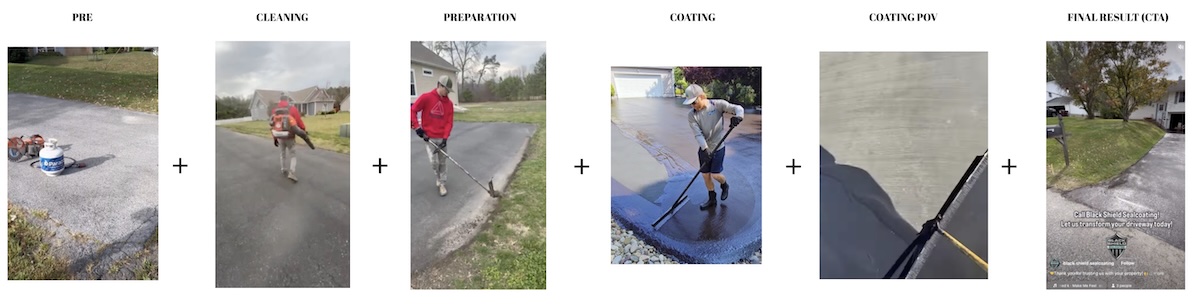
Walk the viewer through the full job from start to finish. Each step builds anticipation for the next — and the final reveal hits harder because they watched you earn it.
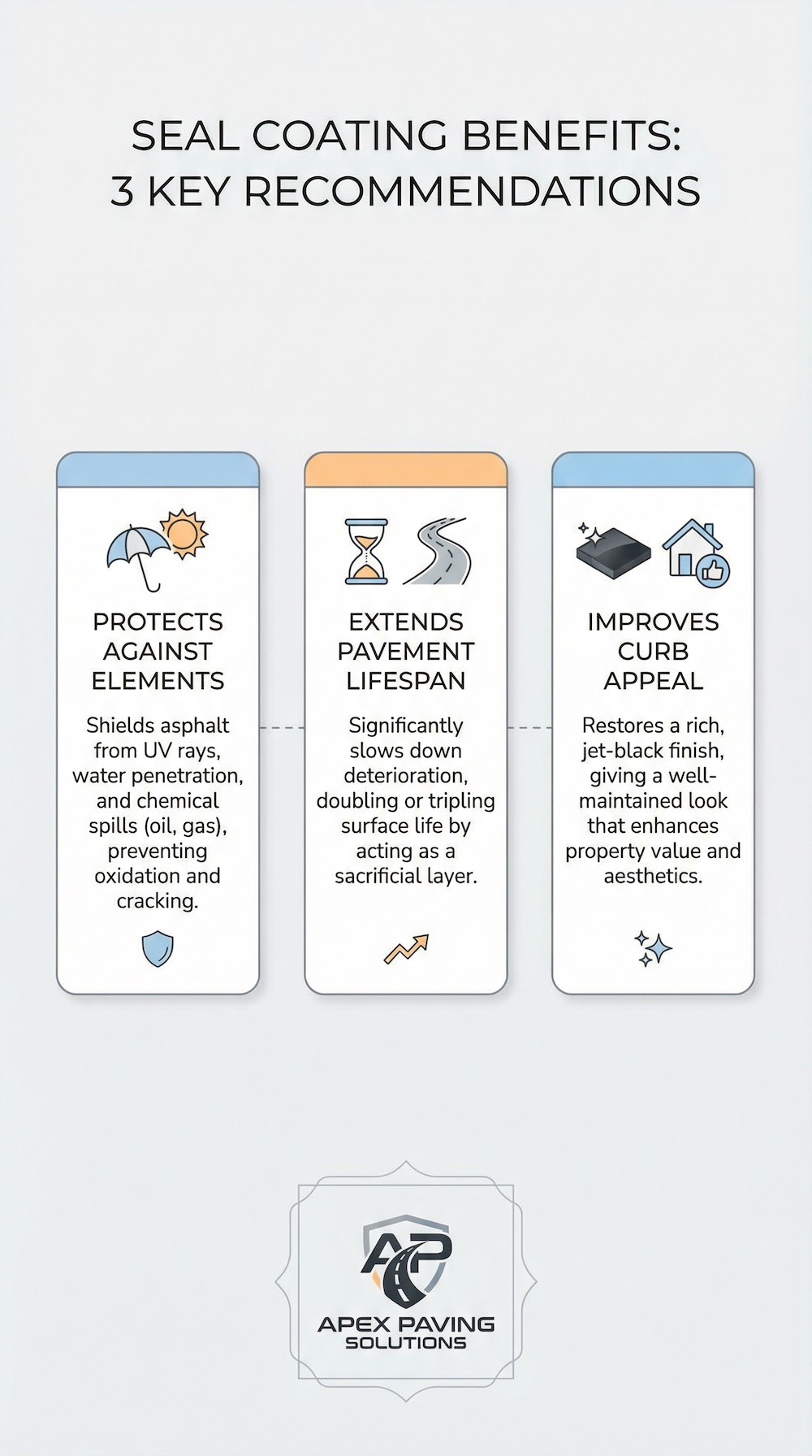
Teach the audience something useful — "How Winter Damages Your Asphalt," "3 Signs Your Driveway Needs Sealing," "Why Sealcoating Now Saves You Thousands Later." Useful content earns saves and shares, which Meta rewards with extra organic reach.
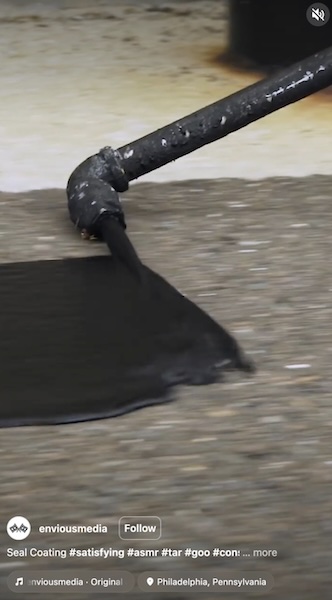
Extreme close-up of the squeegee applying sealer. The texture, the sound, the deep black surface emerging millimetre by millimetre. No narration, no titles — just the craft. This type of content goes viral on pure satisfying watchability. It can stand alone or be woven into any sequence as a "money shot."
The owner talking to camera — why they started, what they guarantee, a day on the job, a job they're proud of. People hire people. A face and a story turns a commodity service into a trusted local business that homeowners want to refer to their neighbours.
A happy customer on camera talking about their driveway — or a quick-cut collage of three to five short clips stitched together. Real faces, real properties, real results. No script needed: "I wasn't sure it would make that much difference — it looks brand new" is worth more than any headline you could write.
How to turn organic content into paid ads
The accounts above prove the content formula. The problem is that organic reach — even with viral posts — is geographically scattered. You can't control whether your before/after reel reaches homeowners in your service area or someone in a different country.
Paid ads fix that. You take the same content that's already proven to stop the scroll and put a location target and a CTA on top of it. The combination is powerful: content that feels native and earns trust, but delivered only to the right zip codes.
Best ad formats for sealcoating on Meta
Instant form vs. landing page — which should you use?
Both work. But they produce different types of leads, and we slightly prefer landing pages for most sealcoating campaigns. Here's why:
- + Full Pixel data — page visits, time on site, scroll depth, form starts. Your analytics knows who came, what they read, and whether they converted.
- + Longer qualification process filters out tyre-kickers. Someone who fills in their address, job size, and preferred timing is more motivated than someone who tapped "Submit" on a pre-filled form in two seconds.
- + You control the experience — before/after photos, reviews, trust signals — all reinforcing the decision before they hit submit.
- + Better remarketing data for future campaigns.
- – Requires a dedicated page and fast mobile load speed. Every extra second costs you leads.
- + No landing page needed — lower barrier to launch.
- + Pre-filled contact info means more raw submissions, lower cost per lead on paper.
- – Zero Pixel data. Meta sees a lead; your analytics sees nothing. No visibility into who converted or why.
- – Low friction cuts both ways. A homeowner scrolling at midnight can accidentally submit a quote request they don't remember by morning. Non-motivated leads waste your follow-up time.
- – Harder to optimise. You can't A/B test the experience or see where people drop off.
Audience targeting
- Core residential: Homeowners aged 35–65, household income $60K+, targeting your highest-converting zip codes. Layer in "homeowner" demographic if available.
- New homeowners: Life event targeting "recently moved" — new homeowners are prime sealcoating prospects who want to protect their investment.
- Lookalike of past customers: Upload your customer list. Meta will find people who look like them in your area. One of the highest-performing audiences once you have 100+ customer records.
- Retargeting (highest priority): Website visitors, video viewers (anyone who watched 50%+ of your content), Instagram profile visitors. Small budget here, very high close rate.
- Commercial: Job titles — property manager, facilities manager, HOA president, building superintendent. Target by employer type too (commercial real estate, property management companies).
Want help turning your Instagram content into a paid lead machine?
Book a 1:1 session — we'll map your content to your ad campaigns and set up targeting that actually converts in your area.
Book a session ($299)Seasonality and budget allocation
Meta Ads for sealcoating follow the same seasonal curve as Google — peak demand April through October in most of North America. Here's how to allocate across the year:
Frequently asked questions
Do Facebook Ads work for sealcoating companies?
Yes — but differently than Google Ads. Facebook and Instagram are interruption channels: people aren't searching for sealcoating, but a well-placed before/after video or photo can stop the scroll and plant the idea. They're especially powerful for retargeting website visitors who found you via Google, for seasonal awareness pushes in spring, and for building a local following that generates referrals.
What type of content works best in Facebook Ads for sealcoating?
Before/after content is king — a fresh black seal coat next to a faded, cracked driveway makes the value viscerally obvious. Time-lapses of the job in progress perform well too. Accounts like @sealcoatinguys and @sealcoatingislife have built large followings on exactly this kind of content — the same format that goes viral organically can be boosted as a paid ad with a location target and a 'Get a free quote' CTA added.
How much should a sealcoating contractor spend on Facebook Ads?
A seasonal push during spring can work with $500–$1,500/month for a local service area. If you're running year-round for commercial clients, $800–$2,500/month covers both prospecting and retargeting. Start lean, prove cost per lead, then scale into what works.
Should I boost Instagram posts or run proper ads from Ads Manager?
Both serve a purpose, but they're not the same. Boosting a post is fast and simple but gives you limited targeting and no real optimisation. Running campaigns from Ads Manager lets you set a conversion objective (leads, calls), define your exact audience, A/B test creatives, and track cost per lead. Use boosts to amplify viral organic content; use Ads Manager for anything you're trying to convert.
What audience should I target with Facebook Ads for sealcoating?
Residential: homeowners aged 35–65, household income $60K+, within your service radius. Layer in life events ('recently moved') to catch new homeowners who haven't sealed the driveway yet. Commercial: target by job title (property manager, facilities manager, HOA board member) in your area. Retargeting list of website visitors is your highest-converting audience — always run that even with a small budget.
Also running Google Ads?
Facebook catches people before they're searching. Google catches them when they are. Both together — with separate budgets and strategies — cover the full funnel for a sealcoating business.
Google Ads for Sealcoating Contractors