In this article
The Real Reason Products Fail
The conventional wisdom is that products fail because of bad marketing. Wrong positioning. Weak copy. Insufficient budget. Poor creative. The assumption is that the product itself is fine, and the failure happened in the communication layer.
Sometimes that's true. But most of the time, when a product consistently fails to attract customers, retain them, or generate word-of-mouth — the problem is upstream of marketing. The product doesn't address a problem that enough people have, feel urgently, and are willing to pay to solve. No amount of advertising can fix that. Advertising amplifies what already exists. If what already exists is a weak signal, it amplifies the weak signal.
The deeper problem is a psychological one. Founders, makers, and builders fall in love with their solutions. The technology is clever. The design is beautiful. The execution is skilled. The passion is genuine. All of those things are real — and none of them are substitutes for solving a problem people actually need solved.
Falling in Love with Your Solution
Here's how it happens. You identify a problem — usually one you have yourself, or one you've seen around you. You build something to solve it. The building process is engaging, rewarding, identity-forming. You get better at building. You become proud of what you've made. And somewhere in that process, the problem you started with recedes into the background, and the solution becomes the thing you care about.
You start describing the solution: the features, the architecture, the elegance of the approach. You start defending the solution when feedback suggests it doesn't work. You start finding customers who "get it" rather than asking why the majority doesn't. You start believing that the market doesn't understand the value yet — that more marketing, better copy, or a different audience will crack it.
This is the cognitive trap of solution-first thinking. The product becomes the point. The problem it was supposed to solve becomes a historical footnote.
The antidote is simple to say and hard to do: fall in love with the problem, not the solution. Keep your primary loyalty to the customer's pain. Let the solution be whatever it needs to be to address that pain effectively. Stay willing to change everything about the solution if the problem demands it.
The Non-Value Zone at the Top of the Pyramid
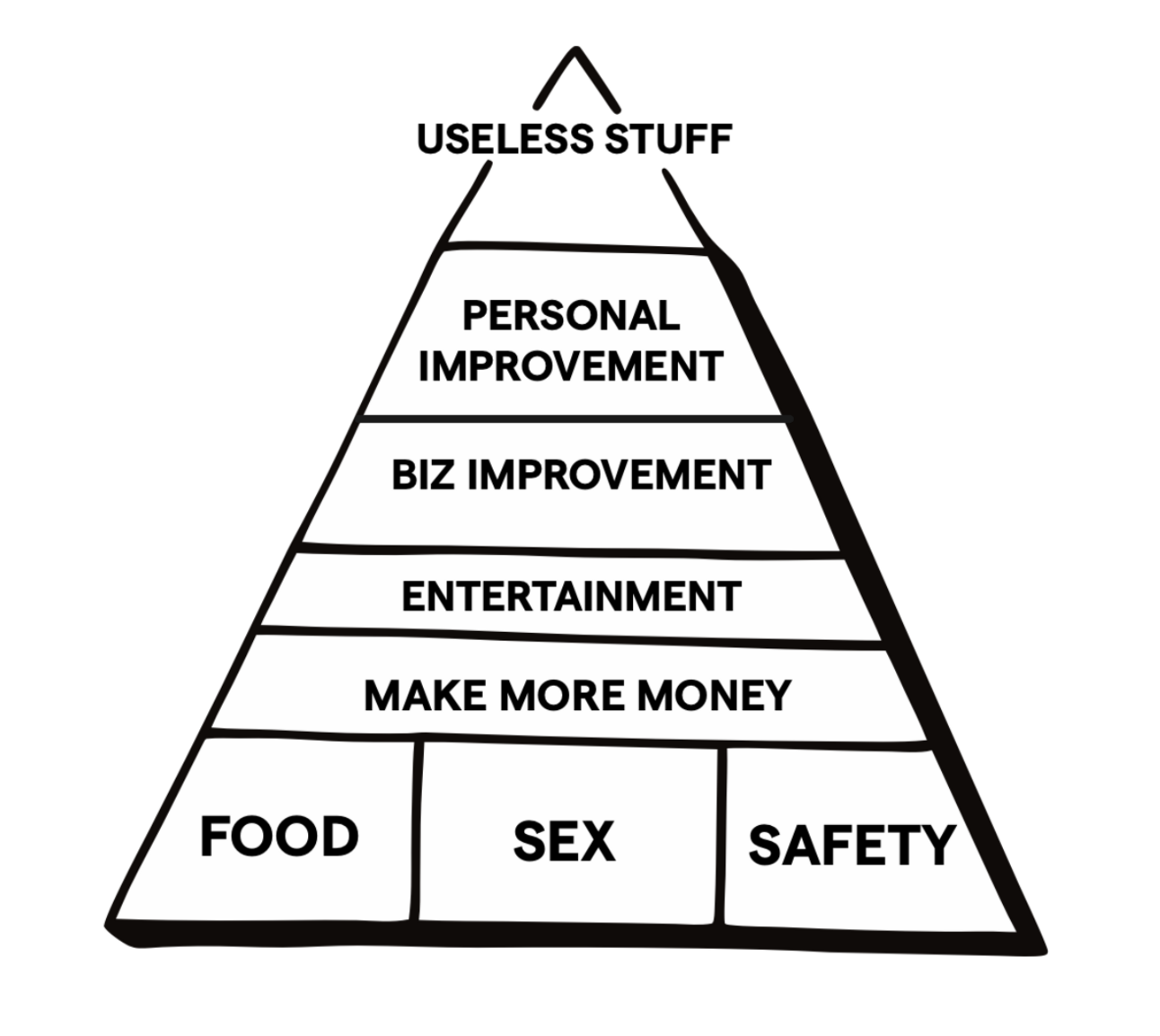
In the hierarchy of human needs — and by extension, the hierarchy of product value — there is a zone at the top where products go to die. Not the self-actualization zone, which is real and commercially potent. The zone above that: the area where products address no genuine need at any level of the hierarchy.
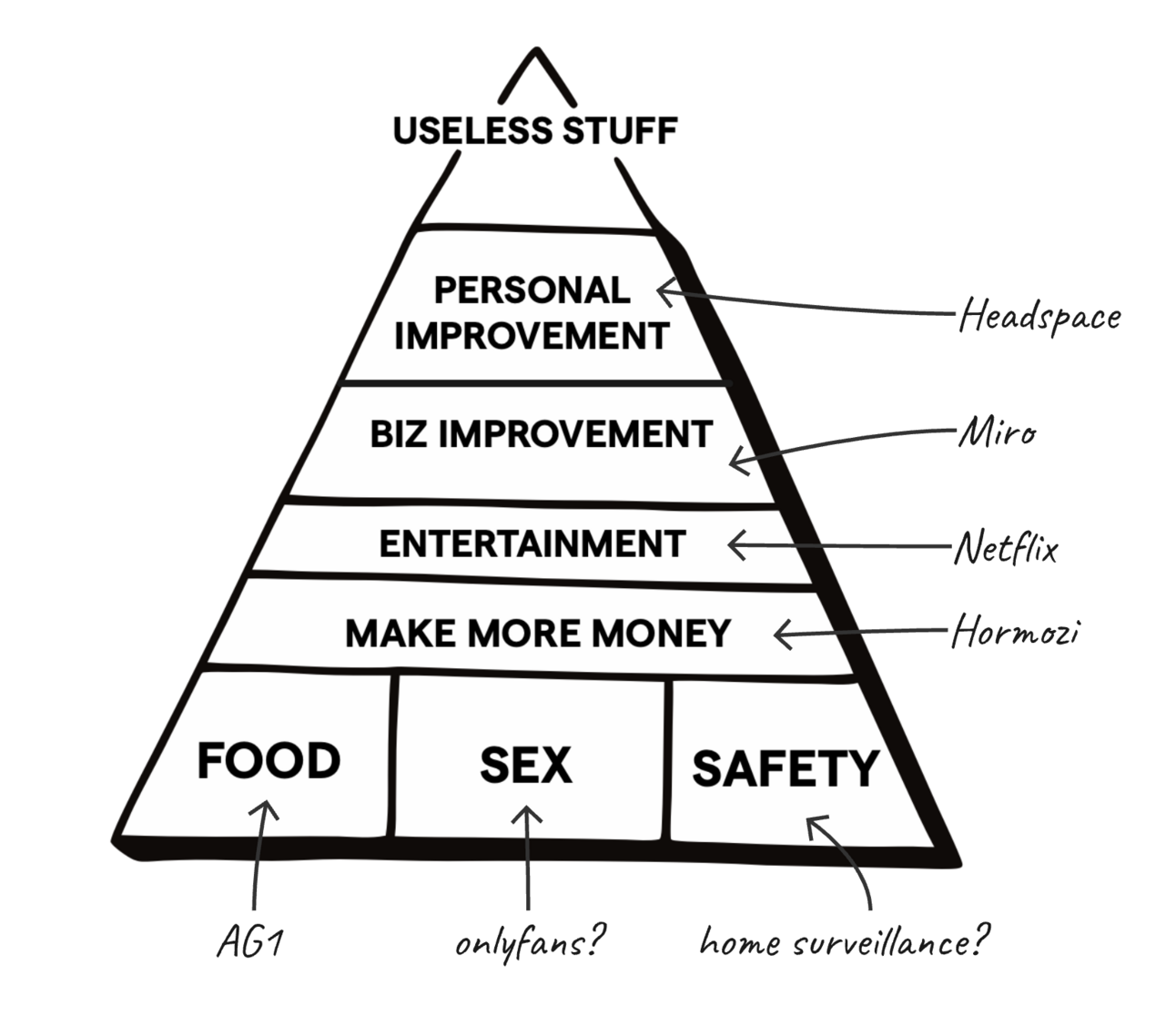
The non-value zone is occupied by products that:
- Require extensive explanation of why you need them
- Solve problems people haven't identified as problems
- Compete against "doing nothing" as the main alternative
- Generate enthusiastic feedback from the founder's network but cold indifference from strangers
- Have low or no organic search volume for their core use case
- Are described primarily in terms of their technology or cleverness, not in terms of the pain they resolve
The useless stuff is where all products with no market end up. If you can't find any honest place for what you're offering in the hierarchy, you have some thinking to do — not about the marketing, but about the product itself.
How to Know If You're Building Non-Value
The warning signals arrive early. Most founders ignore them, or explain them away as marketing problems rather than product problems. The honest check:
No one asks about it without prompting. If the only people who know about your product are the people you've told about your product, demand is weak. Products that solve genuine problems get found. People search for solutions to the problems they have. If there's no search volume, no Reddit threads, no unsolicited inbound — the problem may not be real enough to drive purchase behavior.
You have to explain why people need it. If your pitch requires educating the prospect on the existence of their own problem before you can even get to your solution, you're doing two jobs at once — and the first job is very expensive. Products that address known, felt problems don't need to create problem awareness. The customer walks in already aware. You just need to offer the best solution.
The feedback is qualitative but the behavior is absent. "This is a great idea" from everyone who hears about it, combined with zero paying customers, is one of the most dangerous signals in early-stage product development. Enthusiasm costs nothing. Purchase requires genuine belief that the value is worth the price.
Retention is low even when acquisition works. If advertising generates first purchases but people don't come back, the product isn't delivering on its promise. Marketing attracted the customer; the product failed to keep them. This pattern is impossible to fix with more advertising.
The Problem-First Framework
| Solution-First Thinking | Problem-First Thinking | Outcome |
|---|---|---|
| "We built X — now who needs it?" | "This group has Y pain — what's the best way to solve it?" | Problem-first finds real demand; solution-first hopes demand exists |
| Describes the product in terms of its features | Describes the product in terms of the pain it eliminates | Problem framing converts better at every stage of the funnel |
| Defends the solution when customers don't adopt it | Goes back to the problem when customers don't adopt it | Problem-first pivots efficiently; solution-first dies slowly |
| Expands features to attract more customers | Deepens problem-solving to serve existing customers better | Depth creates retention; breadth dilutes focus |
| Asks "how do we market this?" | Asks "does this genuinely solve the problem better than the alternatives?" | The second question is harder; it also produces better businesses |
The problem-first framework doesn't mean you can't start with an idea for a solution. Most products start that way. It means that as soon as you have a solution hypothesis, you go back to the problem and test whether the solution genuinely addresses it — from the customer's perspective, not your own.
Examples from the Real World
The clearest examples of the solution-first trap are the technology products that raised venture capital, built elegant software, spent heavily on user acquisition, and then discovered there was no retention because the underlying problem wasn't urgent enough to drive habit formation. The graveyard of these products is enormous.
But the more instructive examples are the companies that started solution-first and then pivoted to problem-first successfully:
Slack started as an internal communication tool built by a gaming company trying to coordinate a remote team. The game failed. The communication tool survived because the problem — distributed team coordination — was genuinely painful and widespread. The founders didn't build a communication tool because they'd identified the market. They built it because they had the problem. Then they realized everyone else had the problem too.
Instagram was originally Burbn, a location check-in app with photo features. The location check-in features weren't differentiating. The photo features were. The founders stripped everything except photo-sharing because that's where user behavior was concentrated. They fell in love with what users actually needed — not what they had originally built.
The pattern is consistent: successful pivots happen when founders shift their loyalty from the solution to the problem. They look at what people are actually doing with their product and build more of that, discarding the rest without sentimentality.
Applying This Before You Run Ads
This is the most direct implication of the non-value framework for advertising: you cannot market your way out of a non-value product. Ads amplify what already works — or what already doesn't.
If your product genuinely solves a real problem that people know they have, advertising accelerates growth. It finds more people with the problem, shows them your solution, and lets the product's value do the closing. The unit economics improve as you optimize. Retention holds. Word-of-mouth grows.
If your product is in the non-value zone — solving a problem people don't feel urgently, or solving a problem at the wrong level of the hierarchy — advertising will produce a consistent, expensive pattern: good initial metrics (if your creative is compelling), poor conversion to purchase, catastrophic retention, negative return on ad spend.
Before spending on advertising, the honest question to ask is not "how should I market this?" It's: "Is the problem I'm solving real enough, urgent enough, and widespread enough to generate sustainable demand?" If the answer is uncertain, the advertising budget would be better spent on customer research — talking to people, testing hypotheses, finding where the real pain lives.
The Pyramid as a Validation Tool
Use the hierarchy of needs pyramid as an honest diagnostic before building or before advertising. The exercise:
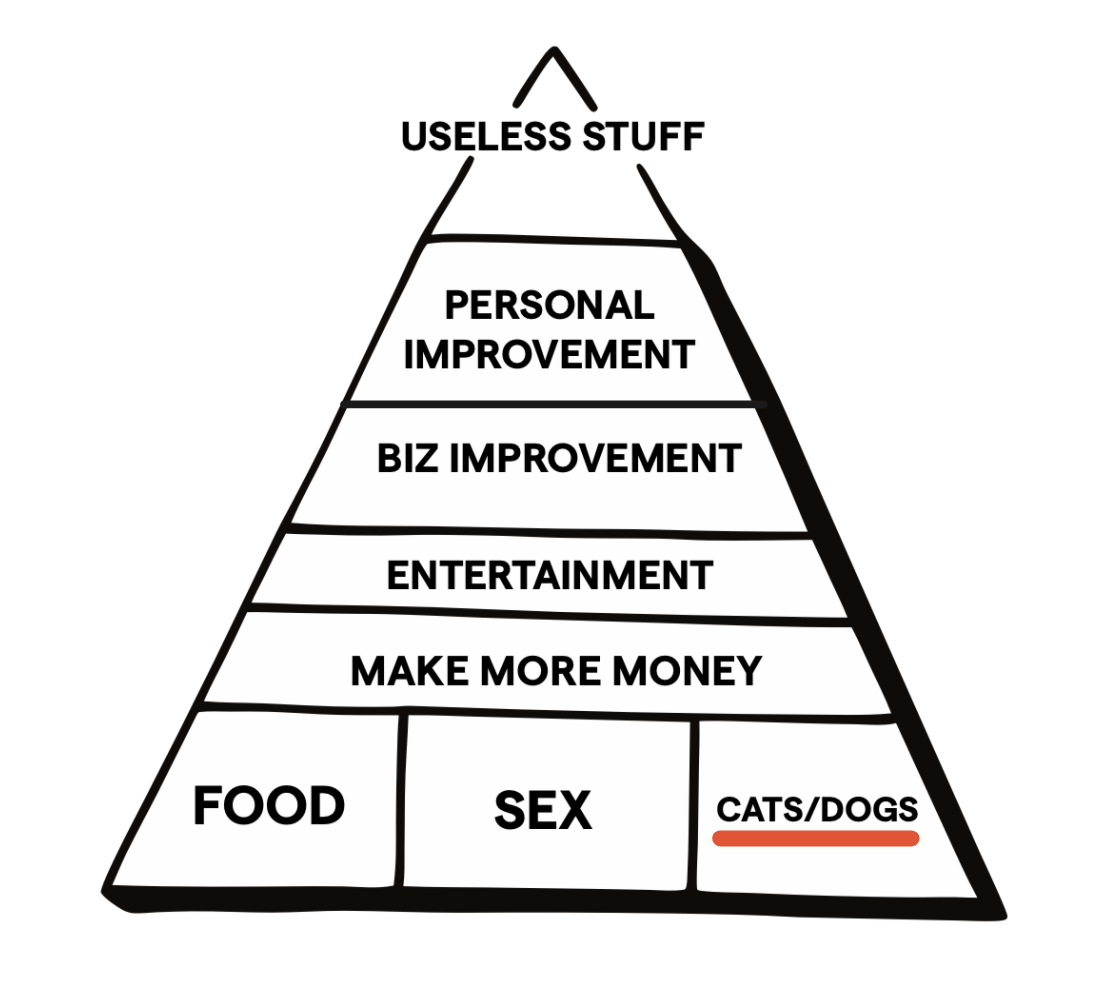
- Place your product honestly on the pyramid. Not where you'd like it to be — where it actually sits based on the problem it solves. If it addresses health, it's at the base. If it addresses status, it's in the middle. If you can't place it anywhere meaningfully, that's important information.
- Check whether the problem is felt at that level. Is there evidence that people in your target market experience this pain? Organic search volume, Reddit discussions, competitor products with real revenue, and customer service complaints from similar categories all provide evidence.
- Check whether the solution is differentiated at that level. If the hierarchy level has strong existing solutions, you need a genuine reason people would switch. "Better UX" is rarely sufficient. Meaningfully solving a dimension of the problem that competitors ignore is.
- Check the promise of value, not just the product. Even if the product is good, is the promise of value communicated in terms the customer cares about? A technically excellent product with a generic or misaligned value promise will underperform a mediocre product with a precisely positioned promise.
This exercise doesn't guarantee product-market fit. Nothing does before real market contact. But it will surface the most obvious reasons a product might end up in the non-value zone before you've spent months building or thousands in advertising finding out the hard way.
Not sure if you have a marketing problem or a product problem?
One session to audit your offer, positioning, and ad performance. We'll tell you honestly where the real issue lives.
Frequently Asked Questions
What does 'fall in love with the problem' mean?
It means directing your primary energy and obsession toward understanding the problem your market has — deeply, specifically, in their own language — rather than toward refining your solution. Founders who fall in love with the problem keep talking to customers, keep iterating, keep questioning their assumptions. Founders who fall in love with the solution stop listening once they've built something they're proud of. The problem-first orientation keeps you honest.
How do I know if my product has real market demand?
The clearest signal is whether people seek it out without being prompted — whether there's search volume, community discussion, unsolicited inbound interest. Secondary signals: people willingly pay without heavy discounting or persuasion; they tell others about it without being asked; retention is high; they'd be genuinely upset if the product disappeared. If you have to explain why people need it, convince them of the problem, or offer deep discounts to get first purchases, demand is weak.
Can good marketing save a bad product?
Short answer: no. Slightly longer answer: good marketing can generate first purchases for a bad product, but it cannot generate repeat purchases, referrals, or word-of-mouth — which are the mechanisms that make businesses sustainable. Marketing amplifies signal: if the signal is 'this product doesn't actually work,' great marketing just tells more people faster. You cannot market your way out of a product-market fit problem.
What is product-market fit?
Product-market fit is the state where your product genuinely solves a problem that enough people have, at a price they're willing to pay, better than the alternatives they currently use. The classic test, from Marc Andreessen's original definition, is whether a significant percentage of your users would be 'very disappointed' if your product disappeared. Ads become dramatically more efficient after product-market fit because every satisfied customer becomes an organic amplifier.
How do I find the real problem my customers have?
Stop asking customers what they want (they'll describe solutions, not problems). Start asking: what are you currently doing to solve this? What's frustrating about that? What would you do if our product disappeared tomorrow? The best problem-discovery interviews make you feel slightly uncomfortable — customers describe pain you didn't anticipate, use language you wouldn't have chosen, and care about things you thought were minor. That discomfort is signal.
Continue Learning
If you've confirmed your product addresses a real need, the next step is understanding the specific emotional motivation that drives purchase. Read The Money Motivation Pyramid for the full hierarchy framework. Then read the triggers framework to understand what specific event turns a passive awareness of that need into an active buying decision.
- Google Ads Coaching — identify non-value patterns in your own campaigns and fix them
- Fix My Google Ads — if your campaigns are generating non-value, get a dedicated audit
- Fix My Facebook Ads — the same non-value patterns apply to Meta; get them diagnosed