In this article
The Brutal Truth About Why People Spend Money
There's a brutal truth that drives us in whatever we are trying to achieve: make money. And to do so, someone else has to give us their money. With all the ethical implications, if we assume we are providing something that has value — and the value is created by the audience most of the time — taking money from customers should not be a problem. If we don't, others will take it.
The question that matters for marketers is not "does my product have value?" Most products do. The question is: "Does my product's promise of value land at the right level of human need to motivate purchase?" Get the hierarchy wrong and you're selling to the wrong desire — even if your product would genuinely help.
Everyone Has a Budget They NEED to Spend
Each and every one of us has a "budget" we need to spend. This isn't just discretionary spending — it's the psychological reality that humans allocate resources toward perceived needs, and as one need is met, another surfaces. Food. Safety. Belonging. Status. Growth. The hierarchy of needs isn't just an academic model — it's a map of where money flows.
As providers of services and products, we should be able to fill these gaps. More ambitiously: we can create new categories of need that didn't exist before. The smartphone didn't satisfy a pre-existing need for a pocket computer. It created a need and then satisfied it simultaneously. AirPods didn't fix a problem people were aware of. They created the experience of untethered audio and then made people feel the absence of it.
Understanding which level of the hierarchy your product addresses — and whether your marketing is speaking to that level — is one of the highest-leverage insights available to any advertiser.
The Modified Maslow for Products
Maslow's original hierarchy runs from physiological needs (survival) at the base through safety, belonging, esteem, and self-actualization at the peak. For product marketing, we can build a modified version that maps more practically to purchase decisions.
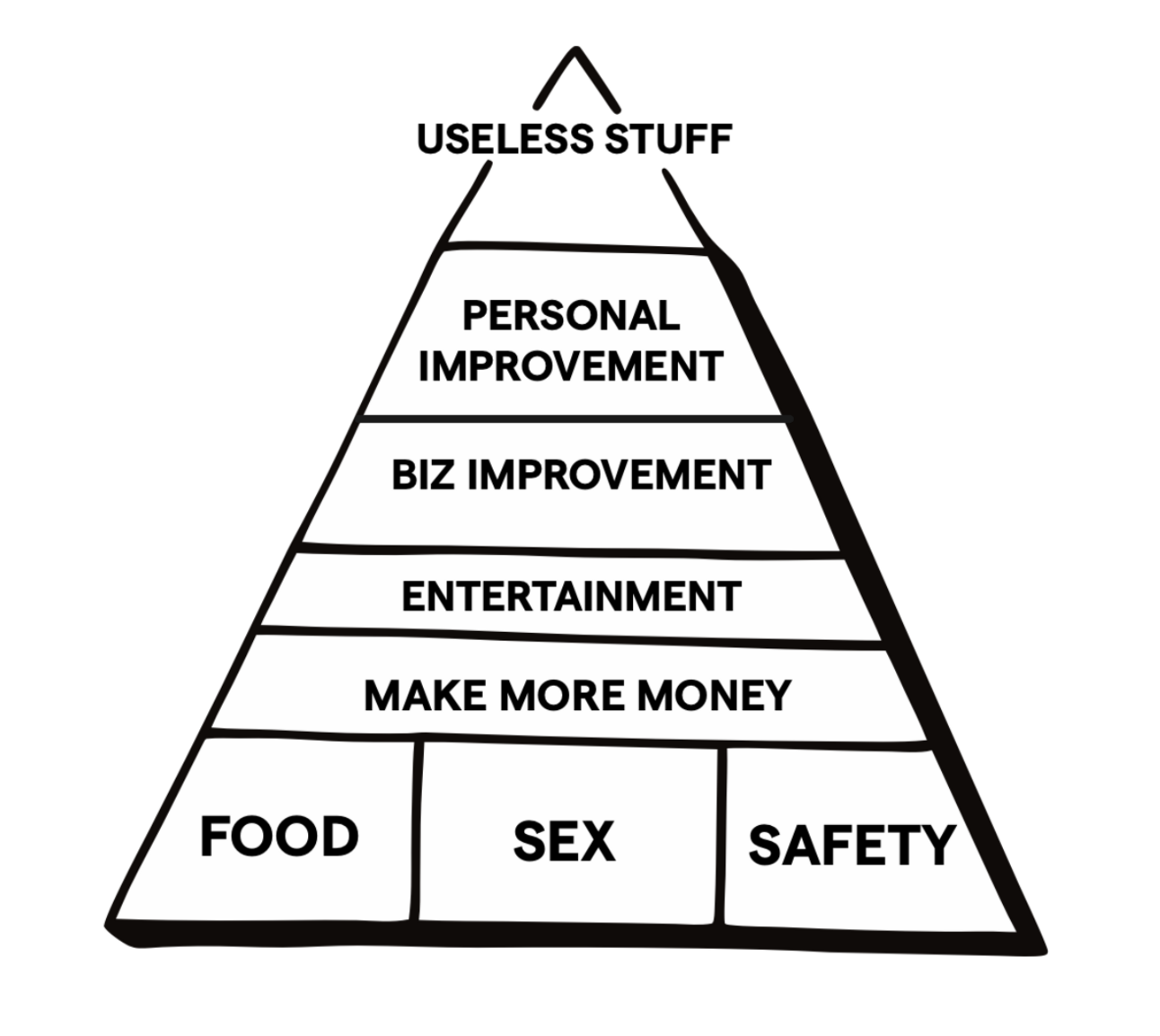
The structure holds: products at the base are purchased out of necessity and fear of loss. Products in the middle are purchased for belonging and status. Products at the top are purchased for identity, growth, and self-expression. And at the very top — the apex of the pyramid — sits what we might call "useless": products that don't fit anywhere meaningful in the hierarchy of human need.
Now let's populate it with real examples:
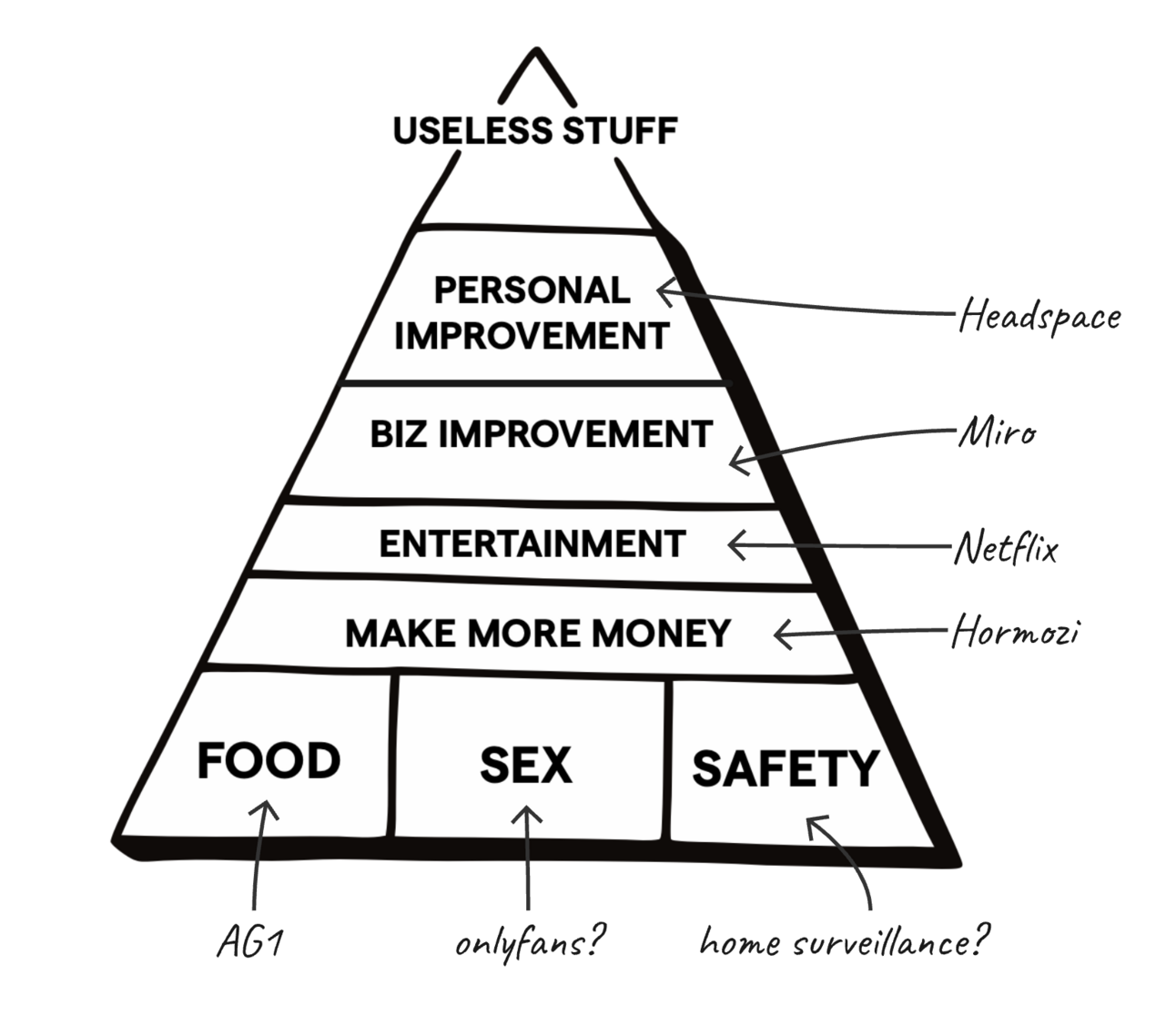
I've put some examples there. Every one of us will have different products to place, but I think this structure covers 99% of what we can think of. The interesting exercise is not to place obvious products — food at the base, luxury goods in the middle — but to challenge yourself on your own product. Where does it honestly sit? And where are you marketing it?
Those two answers are often different. And the gap between them is often where ad performance problems live.
The "Promise of Value" vs Actual Value: The AG1 Example
Here is where the framework gets interesting — and where most marketing analysis goes wrong.
The pyramid doesn't account for the intrinsic value of the product. It accounts for the promise of value. These are not the same thing. AG1 (Athletic Greens) is considered functionally questionable — or at least significantly overpriced relative to its ingredients — by a large number of nutritionists and users. The product's actual value is debatable.
But its promise of value is positioned squarely at the base of the pyramid: comprehensive nutritional coverage, health protection, the kind of foundational wellness that makes everything else work better. That's a physiological need. Fear of missing it is among the most powerful purchase motivators that exist.
The result? AG1 built a nine-figure business on the strength of its promise of value, despite persistent criticism of its actual value. This isn't a moral point about deceptive marketing — it's a structural observation about how purchase decisions are made. People don't buy AG1 because they've evaluated its ingredient list against the science. They buy it because the promise addresses a real, deep fear at the base of the hierarchy.
The lesson: knowing your product's promise of value — and placing it at the right level of the hierarchy — is more important for marketing purposes than the product's technical specifications.
Where Does Your Product Sit? A Practical Exercise
| Product Category | Hierarchy Level | Example Product | Promise of Value | Implication for Ads |
|---|---|---|---|---|
| Health supplement | Physiological / Safety | Vitamin D, AG1, protein powder | "Protect your health, fuel your body" | Lean into fear of deficiency, long-term health outcomes |
| Security software | Safety | VPN, antivirus, password manager | "Keep you and your data safe" | Threat scenarios, peace of mind, protection imagery |
| Dating app | Belonging / Love | Hinge, Bumble | "Find your person, end the loneliness" | Connection, hope, transformation from solo to paired |
| Luxury fashion | Esteem / Status | Gucci, designer handbags | "Signal your success and taste" | Aspiration, identity, belonging to the right group |
| Online course | Esteem / Self-actualization | Skill-building, business courses | "Become the person you want to be" | Transformation narrative, future identity, concrete outcomes |
| Productivity app | Esteem / Self-actualization | Notion, Obsidian | "Build the systems that make you who you want to be" | Identity-level copy, community of optimizers, visible results |
The column that matters most for advertising is the "Promise of Value" column — because that's what your ads need to communicate, not the feature list. And the "Implication for Ads" column tells you the emotional register your copy should operate in.
Why This Matters for Advertising
If you're selling at the wrong level of the hierarchy, your ads will fail — even if the product is good, the creative is compelling, and the targeting is right. Because you'll be speaking to a motivation that your audience isn't feeling at the moment they see your ad.
A dating app that markets itself on safety and privacy features is speaking to level two (safety) when its customers' actual desire is level three (belonging). The messaging misses the emotional target entirely. A luxury brand that talks about quality and craftsmanship is speaking to the product when the customer is buying status — a level four purchase motivation that doesn't care about thread count, it cares about recognition.
The hierarchy also helps you understand competitive positioning. A product at the same hierarchy level as a strong incumbent needs to find a different emotional angle within that level, or differentiate by moving to an adjacent level. Competing purely on features within the same motivational territory is a race to the bottom.
The Variation That Changes Everything
Now that I think about it more, there's a small variation to the pyramid that will make more sense:
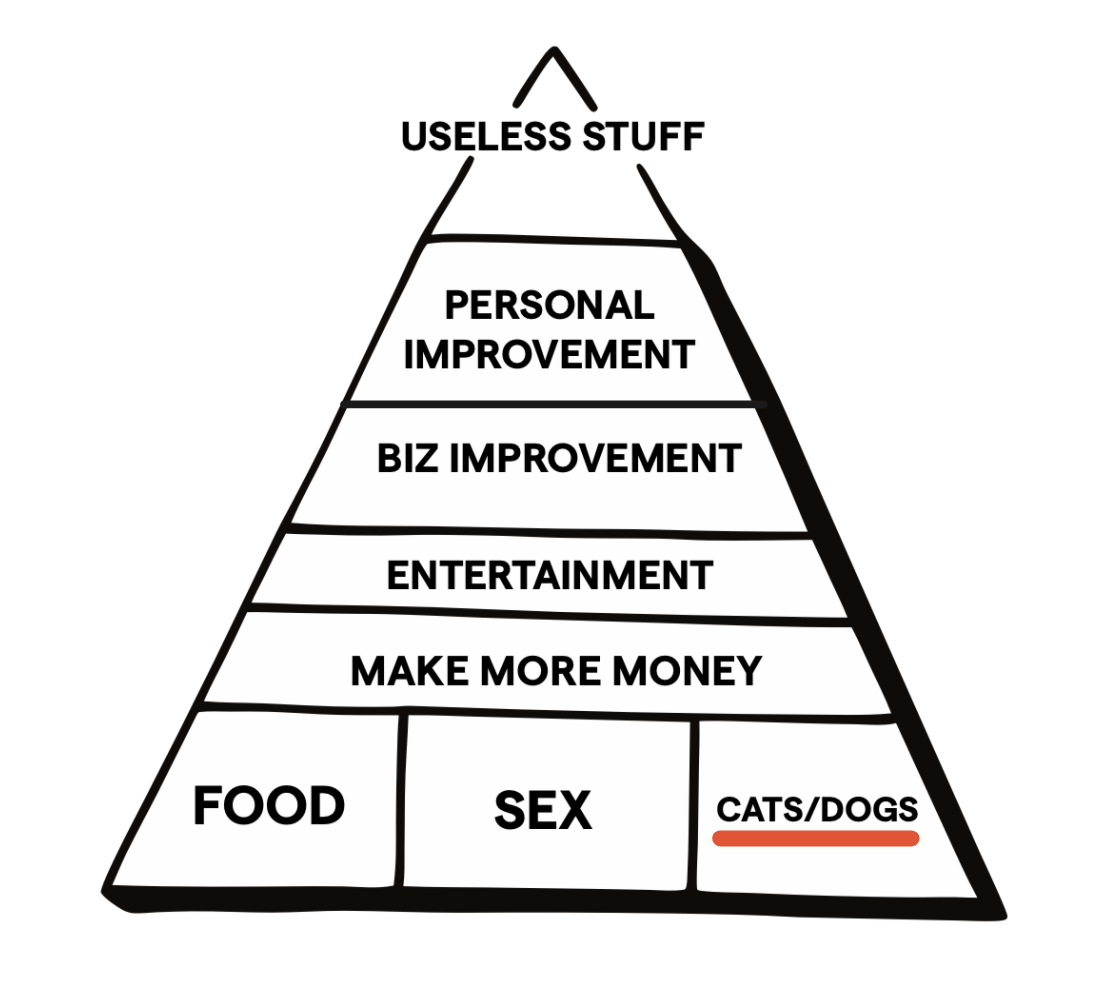
The variation is this: within each level of the hierarchy, there is a spectrum from functional to aspirational. A product that addresses health needs can be marketed functionally ("prevents vitamin deficiency") or aspirationally ("this is what your best self looks like"). The same product, the same hierarchy level — but radically different emotional registers.
The higher you are on the aspirational spectrum within your level, generally the higher the price tolerance and the lower the price sensitivity. People who buy something for aspiration, identity, or status are not price-shopping — they're buying a feeling. People who buy something for pure function are comparing prices on Amazon. Knowing where you sit on the functional-to-aspirational axis within your hierarchy level tells you a huge amount about how to price, how to market, and who to target.
Applying This to Ad Copy
| Hierarchy Level | What the Customer Really Wants | Ad Angle That Works |
|---|---|---|
| Physiological | Survival, health, energy, sleep — the basics of functioning | Fear-based (what happens without it), before/after transformation, clinical authority |
| Safety | Protection from loss, risk, harm, or the unknown | Threat scenarios, peace of mind, "protect what matters," ease of implementation |
| Belonging | Connection, community, being part of something | Community proof, "people like you," shared identity, relationship outcomes |
| Esteem / Status | Recognition, respect, visible success, social signaling | Aspirational imagery, who uses this, what people will notice, the signal it sends |
| Self-Actualization | Growth, mastery, identity evolution, becoming who you want to be | Transformation narrative, future identity, mastery and expertise, long-term arc |
The critical thing to remember: your ad needs to speak to where the customer already is emotionally, not where you think they should be. If your audience is in fear mode (safety level), an aspirational ad about self-actualization won't land. Meet them where they are.
Know where your product sits. Build ads that speak to it.
In a single coaching session, we'll map your product to the right motivational level and rebuild your advertising angle around what your customers actually want.
Frequently Asked Questions
What is the Maslow hierarchy in marketing?
Maslow's hierarchy of needs is a psychological model that ranks human needs from basic survival (food, shelter) to higher-order desires (esteem, self-actualization). In marketing, it's used as a framework to understand what layer of need your product is actually addressing — which determines the emotional angle your advertising should take. A product that addresses survival needs markets very differently from one that addresses status or identity needs.
How do I find where my product fits in the hierarchy of needs?
Ask yourself: what would happen to a customer if they didn't have your product? If the answer involves genuine hardship (health, safety, financial survival), you're near the base. If the answer involves social embarrassment or missed opportunity, you're in the middle. If the answer is mainly that they'd miss out on optimization or self-expression, you're higher up. Also look at who your most enthusiastic customers are and what they say about how your product changed their life — the language they use will tell you exactly which level you're addressing.
Why do bad products sell and good products fail?
Because marketing is about the promise of value, not the intrinsic value. A product with a weak promise but strong demand will outsell a technically superior product with a weak marketing position every time. AG1 (Athletic Greens) is the canonical example — widely criticized for modest efficacy, but its promise of comprehensive nutritional coverage taps directly into health needs at the base of the pyramid. The promise is compelling. The reality is debatable. The sales are undeniable.
What is the 'promise of value' in marketing?
The promise of value is what customers believe they're buying — the transformation, the status, the feeling — not the literal product. People don't buy a gym membership; they buy the feeling of being someone who exercises. They don't buy a luxury car; they buy the confirmation that they've earned a certain level of success. Understanding the promise of value lets you market to what customers actually want rather than what you're technically selling.
How does understanding motivation improve ad performance?
When you know which level of the pyramid your product addresses, you can speak to the right motivation. A product at the health/safety level needs to address fear of loss. A product at the social level needs to address belonging and status. A product at the self-actualization level needs to address identity and aspiration. Ads that speak to the right motivational layer convert at much higher rates than generic ads, because they feel personally relevant to the customer's actual desire — not just their stated problem.
Continue Learning
Understanding where your product sits in the hierarchy is the foundation. The next step is understanding the specific event that makes your customer act — that's what the triggers framework covers. And if you want to see how all of this connects to page structure, read the landing page structure guide.
- Google Ads Coaching — apply the motivation hierarchy to your Google Ads copy and campaign strategy
- Facebook Ads Coaching — use motivation frameworks to build Meta audiences and creative that convert